Multichain payments.
Straight to wallets.
Accept stablecoins and digital assets on major networks. Payments go straight to merchant and partner wallets, or are credited to the merchant balance for withdrawal.
 Smart contract
Collection, splits and settlement on one platform.
The checkout, merchant console and operations console share the same records, and every payment links to its on-chain transaction.
Hosted checkout
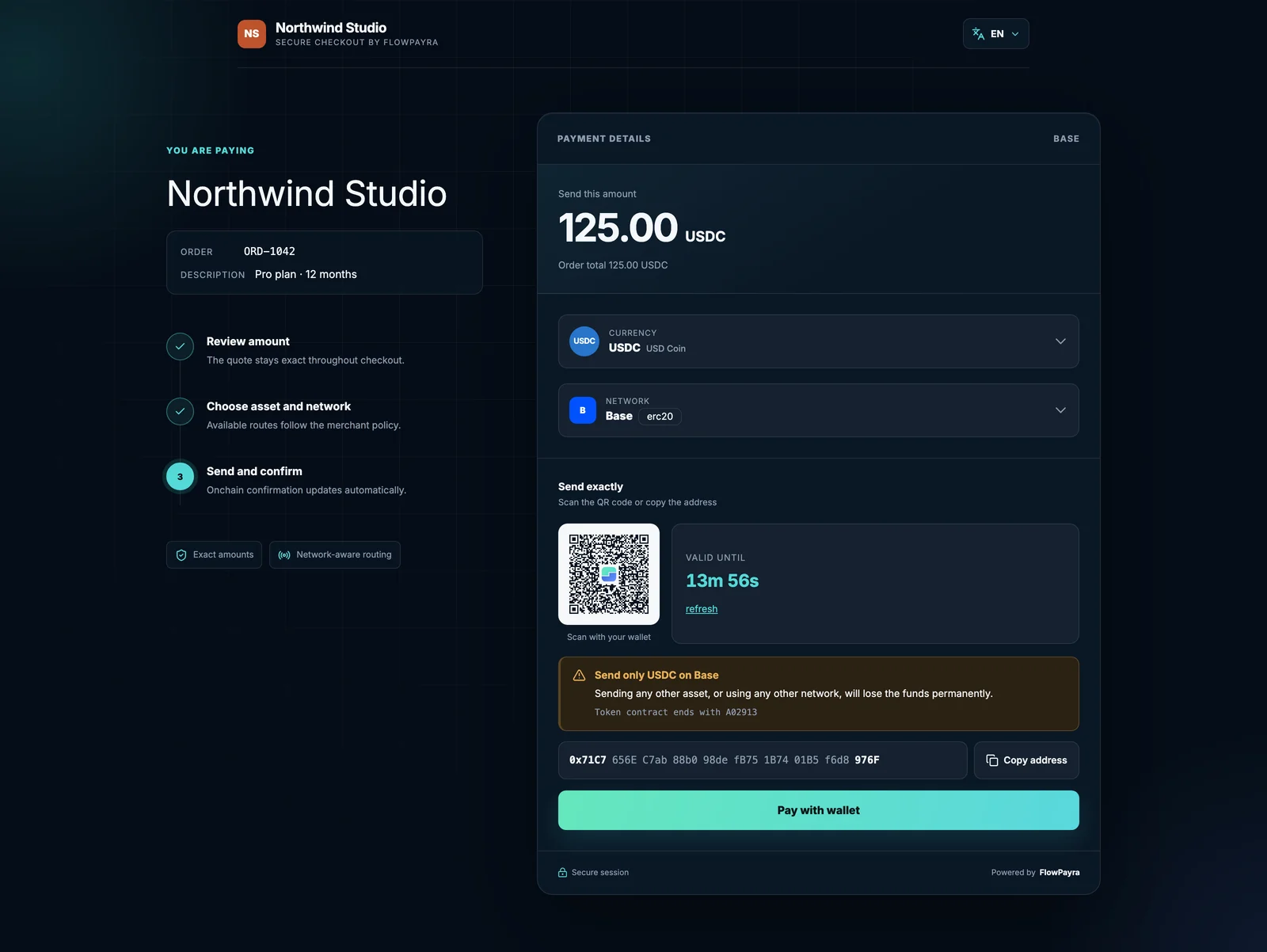
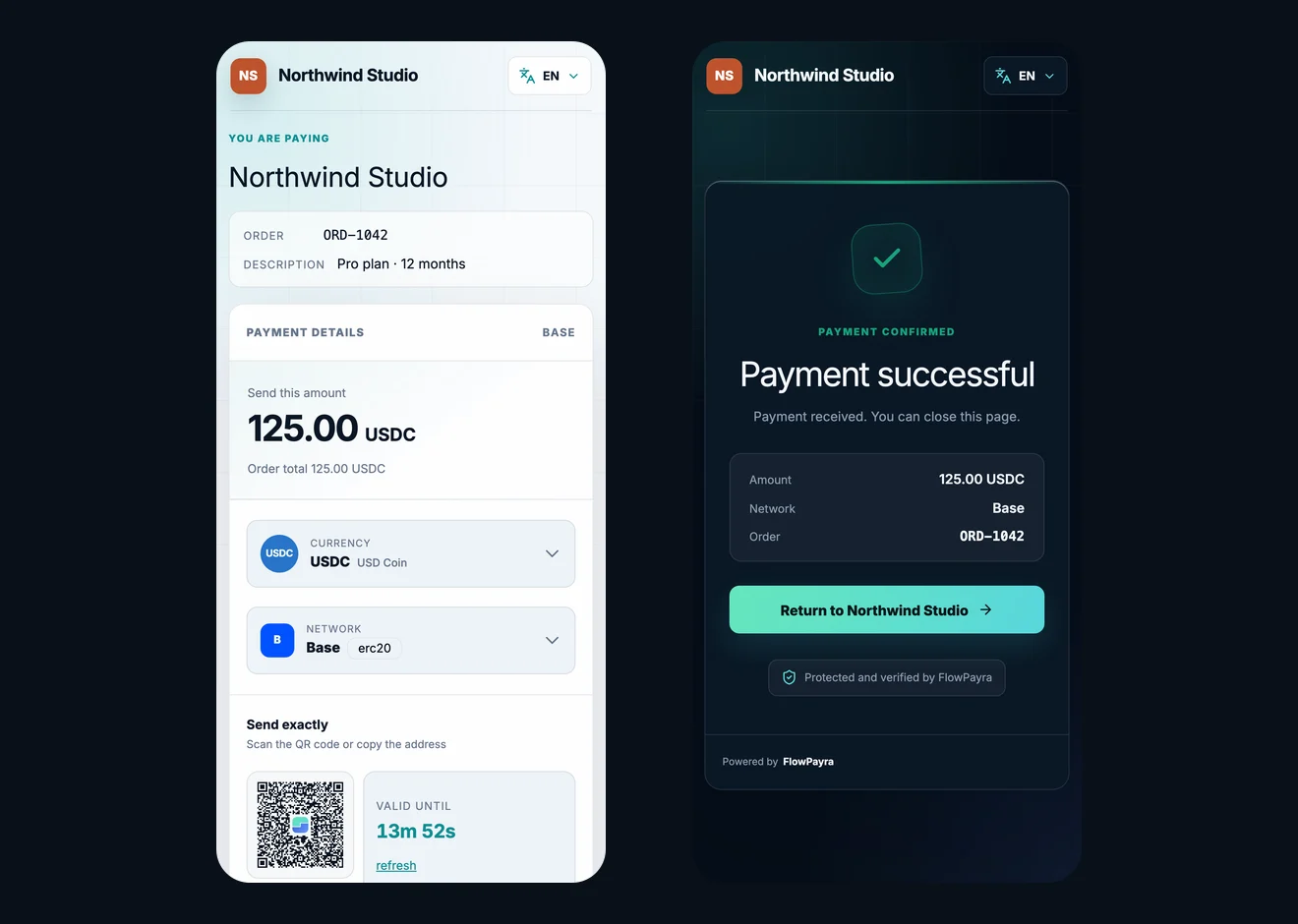
Buyers choose the asset and network, then pay from a wallet or by QR code.
01Subscriptions and usage billing
Recurring billing, plus per-request and metered pricing for APIs and AI services through x402.
02Balances and payouts
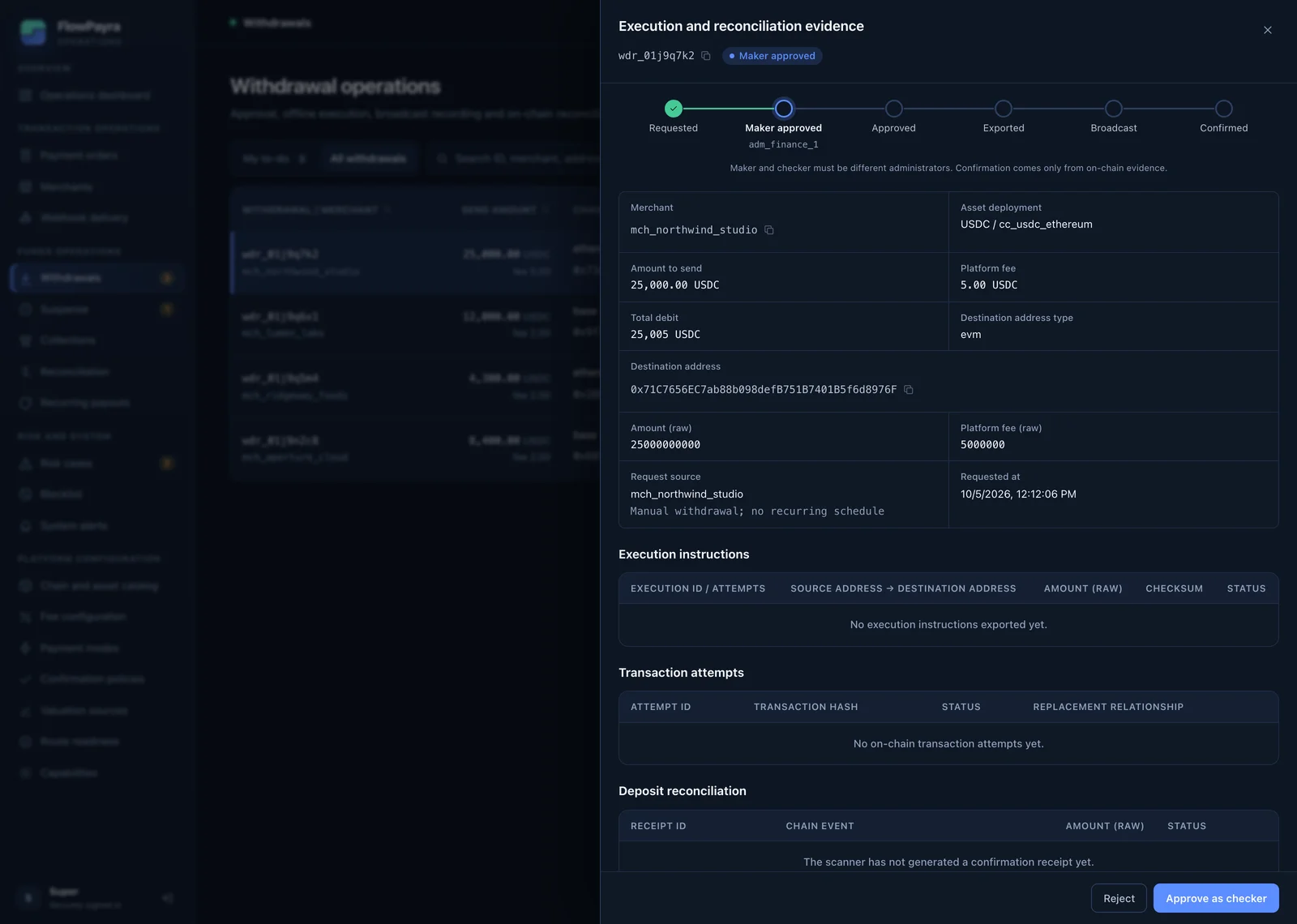
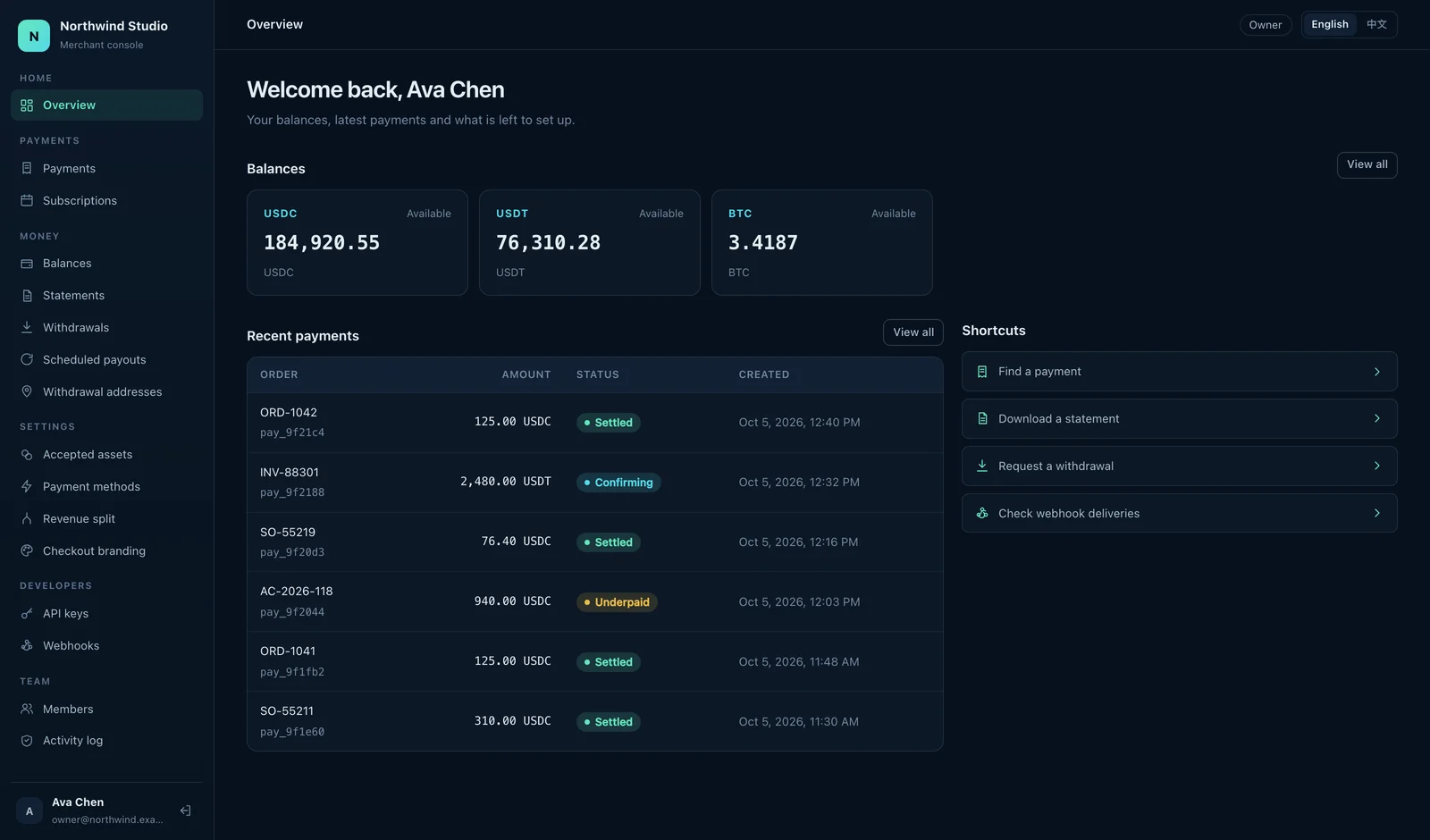
Merchant balances, statements, withdrawals and scheduled payouts, with dual approval for every payout.
03Revenue splits
Each payment can be shared between the merchant and multiple partners.
04Two payment modes for different business models.
Merchants offer one or both, and buyers choose at checkout.
Pay from wallet
The buyer pays once, and the smart contract sends each share to its recipient.
- Buyer wallet
- Smart contract
- Recipient wallets
- Settlement
- Funds reach merchant and partner wallets as soon as the payment confirms
- Splits
- By percentage, between the merchant and its partners
- Networks
- EVM networks, Tron and Solana
- Best for
- Merchants and platforms that want funds in their own wallets immediately
Transfer to address
The buyer transfers to the order address, and the confirmed payment is credited to the merchant balance.
- Buyer wallet
- Deposit address
- Balance
- Withdrawal
- Settlement
- Credited to the merchant balance, then withdrawn or paid out on a schedule
- Splits
- By percentage or fixed amount
- Networks
- EVM networks, Tron, Solana and Bitcoin
- Best for
- Subscriptions, usage billing and businesses that manage balances centrally
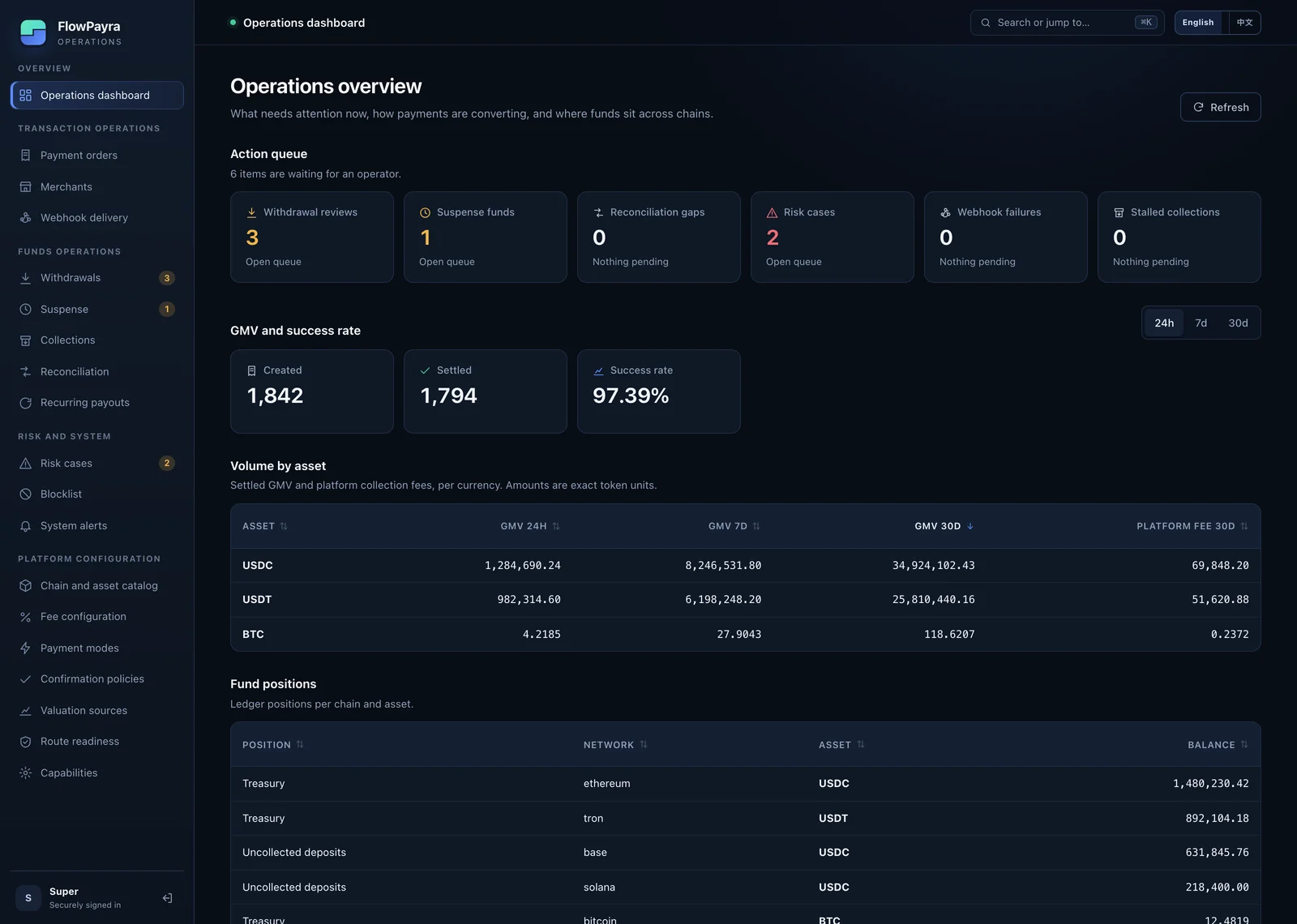
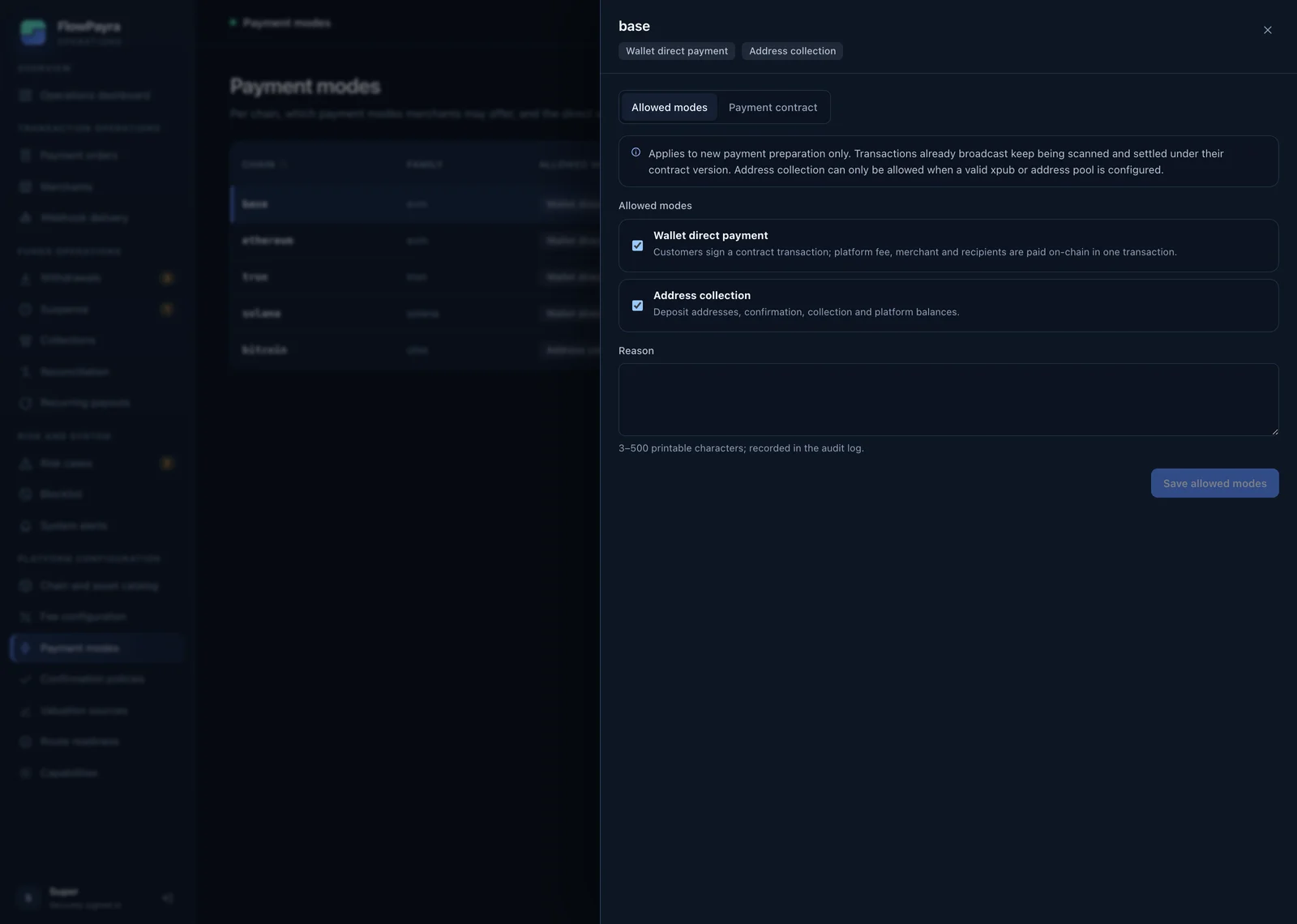
Interfaces for every role.
Three purpose-built interfaces: the platform operations console, the merchant console and the hosted checkout.
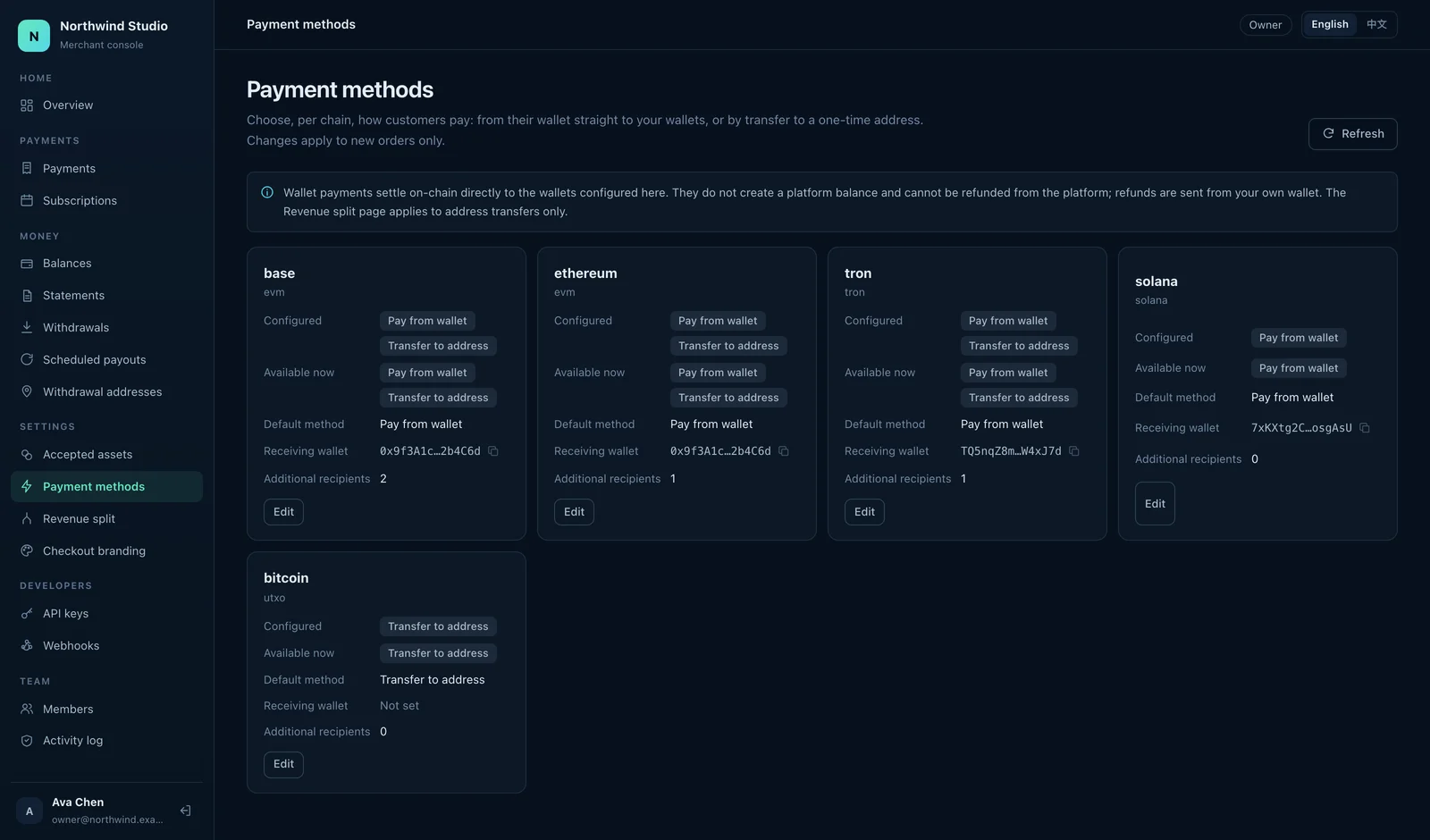
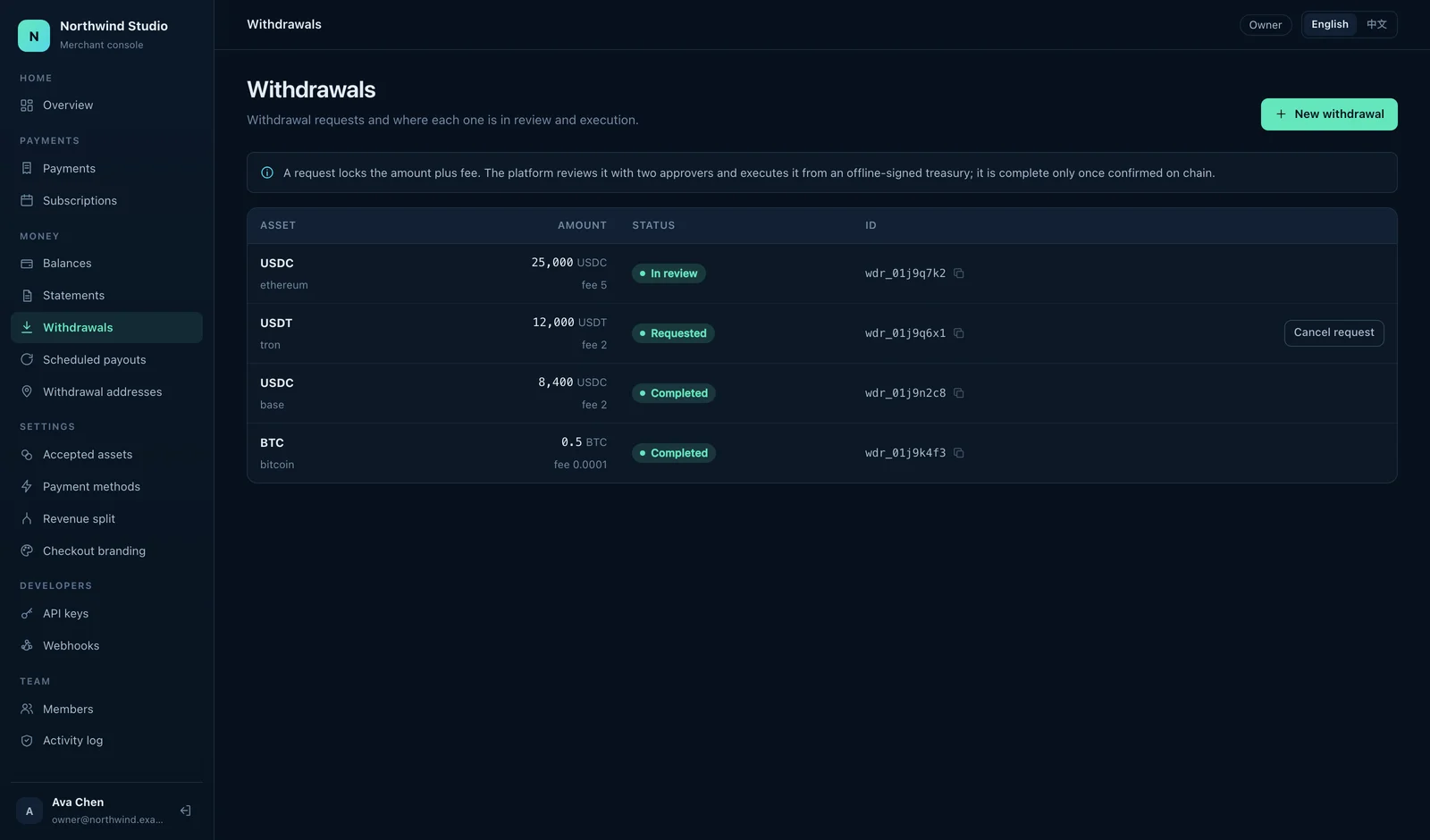
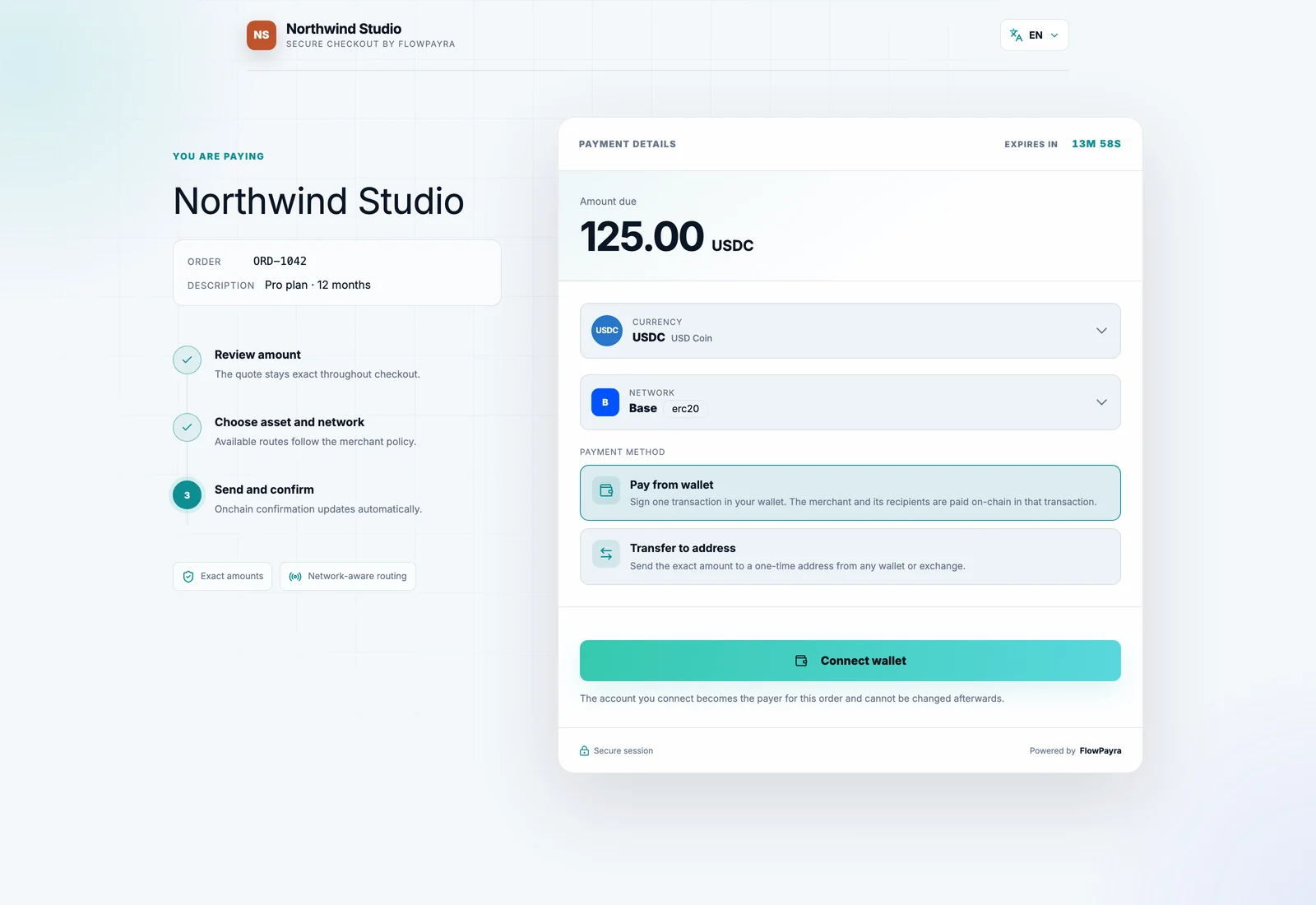
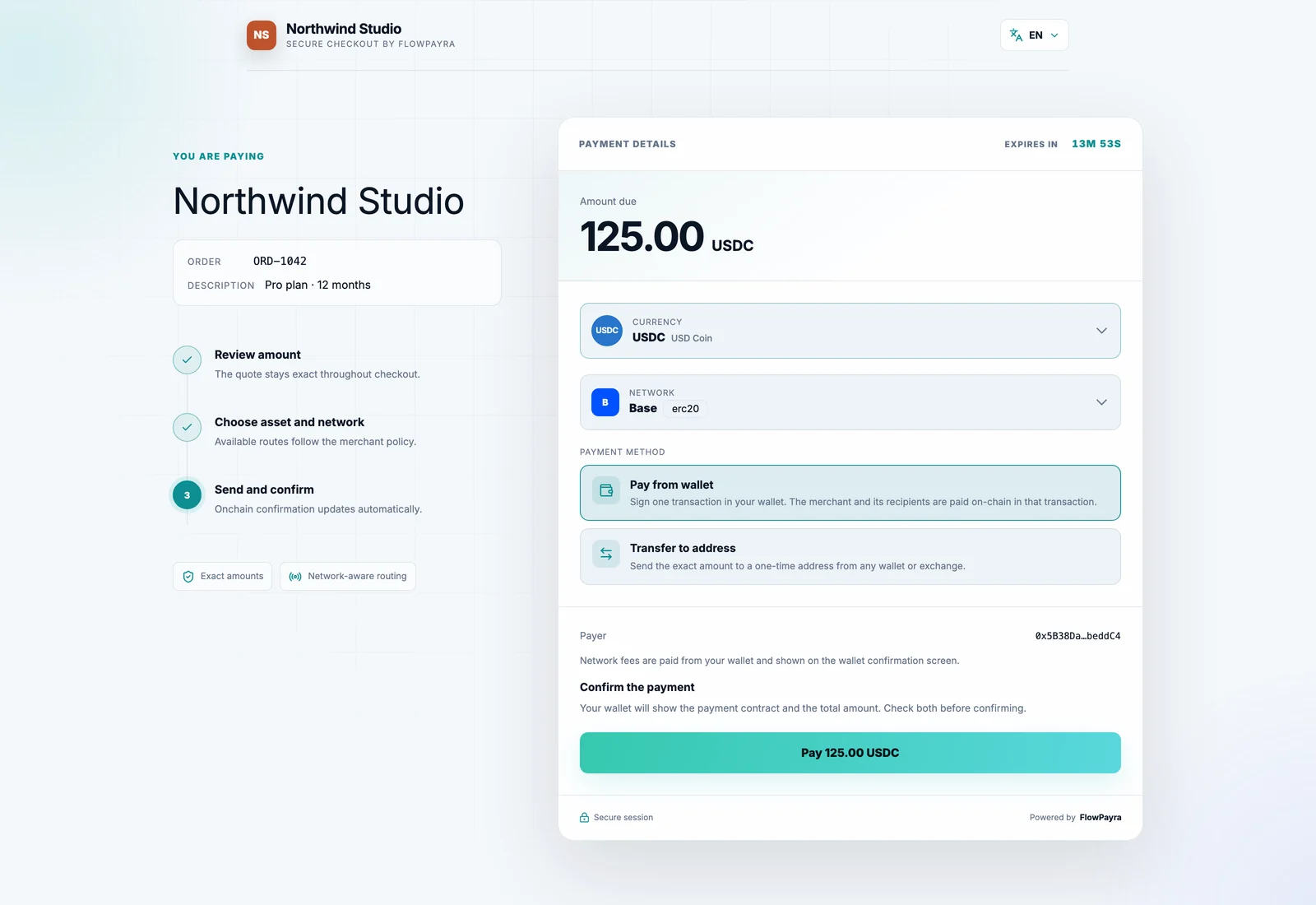
Major networks, one integration.
EVM networks, Tron and Solana support both payment modes. Bitcoin supports Transfer to address.
EVM
ETH · USDC · USDT
Both payment modesTRON
TRX · USDT
Both payment modesSOLANA
SOL · USDC · USDT
Both payment modesBITCOIN
BTC
Transfer to addressFrom order to settlement in three steps.
Create
Create an order through the API or the checkout button.
Pay
The buyer chooses a network and payment mode, then pays from a wallet.
Settle
Once the payment confirms, the merchant’s system is notified and funds reach the wallet or balance.
Built for commerce, AI services and platforms.
Global crypto checkout
Accept stablecoins and major digital assets from buyers worldwide.
POST /v1/inference200x402 payments for agents
Charge API and AI service callers per request or by usage.
Splits and payouts
Share each payment with partners and pay out on a schedule.
Treasury keys stay offline.
Every transfer out of the treasury is signed on an isolated offline signer.
- ✓Treasury private keys are held only on the offline signer
- ✓Withdrawals and payouts require dual approval and are fully audited
- ✓Wallet payments authorize the exact order amount
- ✓The ledger is reconciled with on-chain balances continuously
Create a payment with a single request.
REST API, TypeScript SDK, webhooks and a checkout button. API keys stay on the merchant’s server.
import { FlowpayraClient } from '@flowpayra/sdk';

const flowpay = new FlowpayraClient({
  baseUrl: 'https://api.flowpayra.com',
  keyId: process.env.FLOWPAY_KEY_ID,
  secret: process.env.FLOWPAY_SECRET,
});

const payment = await flowpay.payments.create({
  merchant_order_no: 'order-1042',
  quotes: { cur_usdc: { amount: '24.90' } },
});Frequently asked questions
01Which networks and assets are supported?+
Stablecoins and native assets on EVM-compatible networks, Tron, Solana and Bitcoin. Bitcoin supports Transfer to address.
02How do the two payment modes differ?+
With Pay from wallet, a smart contract sends each share straight to the merchant and partner wallets. With Transfer to address, the payment is credited to the merchant balance, then withdrawn or paid out on a schedule.
03Who chooses the payment mode?+
Merchants enable one or both modes and set a default. When both are enabled, the buyer chooses at checkout.
04How are funds protected?+
Treasury private keys are held on an offline signer, and withdrawals require approval. Wallet payments are signed in the buyer’s own wallet.
05Is usage-based billing for AI services supported?+
Yes. x402 supports per-request and metered pricing, and unused authorization is returned to the payer’s balance.
Discuss your payment requirements.
Share your business model, target networks and settlement requirements, and we will propose an integration plan.
Contact sales